LEX: Wizard of Words — a 1988 game, rebuilt by an LLM in an hour
LEX: Wizard of Words was an educational spelling game I played an awful lot as an 8-9yo. It was written by John Grimley and published in 1988 by Reckon Software Pty. Ltd. in Sydney. This was unusual for the era as it was an Australian game on an Australian kid's computer (which at the time was an Amstrad 286 running MS-DOS 3.2 on a 12mHz CPU).
The game was straightforward. You walk one of eight trails through a forest towards a distant castle. LEX, a wizard in a robe, holds up a word; a line of four hooded Word Wardens each carry a letter — V, L, U, P. The letter on LEX's own robe tells you what kind of answer he wants: S for a synonym, H for a homophone, ? for an anagram, and so on. The wardens give you the number of vowels, the length, the last, and first letter of the word as clues respectively as hints each time you get it wrong. Answer correctly and you take a step towards the castle. Keep getting it wrong, and the Spelling Serpent gives you one last chance. That's the whole game, but it was very compelling at the time.
I still had the disks, so I pointed Claude at them (the data files, a running copy in DOSBox, and a pile of screenshots) and asked it to rebuild the game to run in a browser. The version below is roughly an hour of Claude Opus 5, plus 20 minutes to put the endgame in after I noticed it was wrong.
If you want the real thing rather than my imitation of it, John Grimley has given permission for the original to be archived, and it is now up at the Internet Archive: archive.org/details/lexwizardofwords — both disk formats, a scanned manual, and a couple of save games from the previous owner. Run it in DOSBox. It is worth the ten minutes.
Play it
It plays much better with more room — open the current version in its own tab. Type your answer and press Enter. Progress saves to your browser.
Opus 5 versus Sonnet 4.6
I'd tried building this six months earlier with Sonnet 4.6, and that attempt is
behind the second button. I've left it up because the contrast turned out to be
interesting. Same brief, same source material, same puzzle data — I
reused Sonnet's puzzles.js unchanged, so the actual questions are
identical between the two.
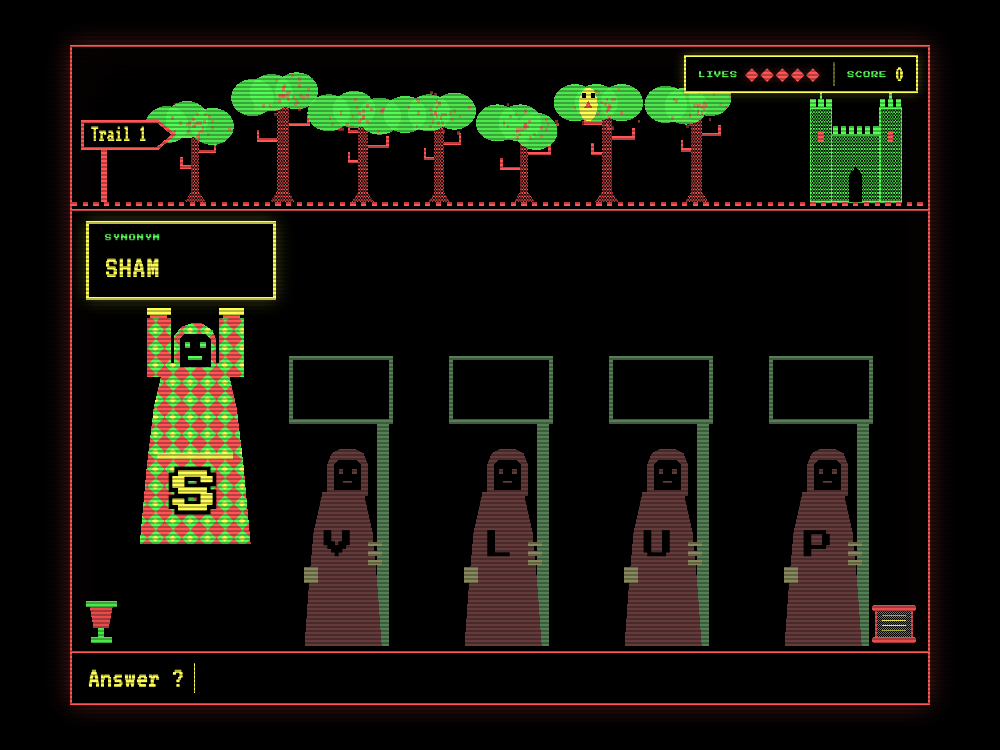
Here they are side by side, both stopped on the same kind of puzzle — a synonym, with the S on LEX's cloak. Both models got that mechanic right. Everything else about the two screens is a choice.
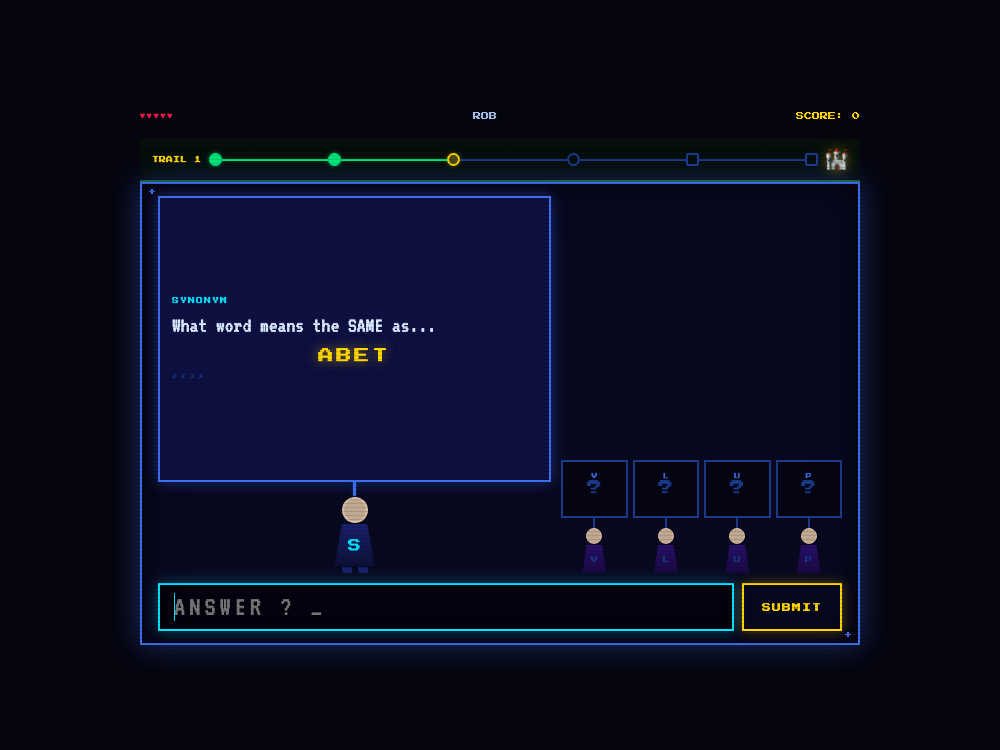
Sonnet understood the rules perfectly (which to be fair is impressive). Where it failed was in everything that makes Lex feel like a game. It never drew a forest or a castle at all. It built the wizard and the wardens out of stacked CSS boxes, so they came out as person-shaped blobs about a centimetre tall, stranded in a mostly empty screen. And it made up its own palette with many colours, glows, and drop shadows, none of which a CGA display could physically produce.
Opus instead chose (without specific instruction) to write a sprite library and placed the wizard, the wardens, the trees and the castle as actual pixels, in the four colours CGA mode 4 really had with dithering in pairs where it wanted a fifth, which is the trick the original used for LEX's robe. That one decision accounts for most of the difference between the two screenshots. Both models were handed the same reference material; they made different assumptions about what a "retro" game meant.
The 1988 version is still better
Neither of these, however, is anywhere nearly as good as the original, which was written by hand to fit on a floppy disk, on hardware with four colours and no help whatsoever.
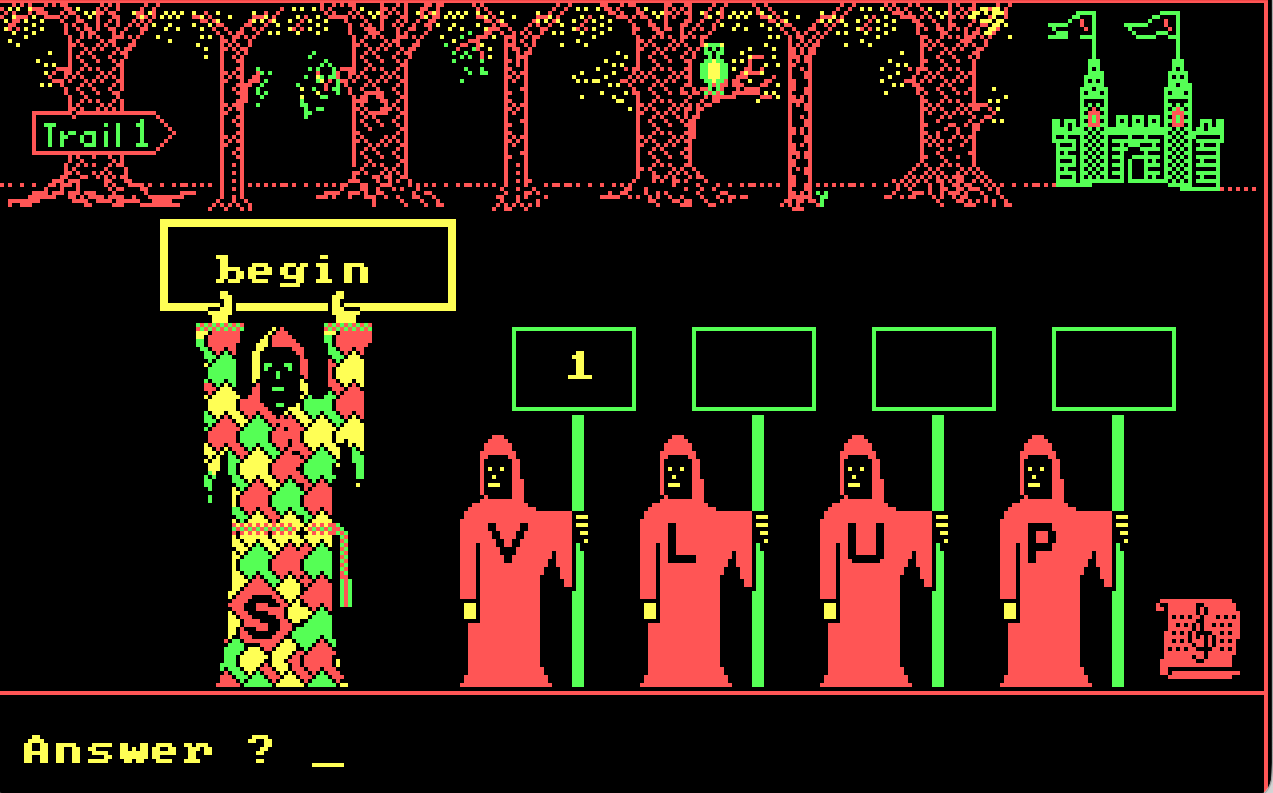
The real thing, 1988.
The original's forest / trail path is denser and far more varied, where the recreation settles for a tidy row of lollipop trees. Its castle has depth and detail. LEX himself is a proper character with a face and a posture. The original also has sound, and animation between trail steps, and the developers had a clear focus on fine-tuning a game.
The puzzles, though, are nearly all there. Claude read it straight out
from the files: 349 of 351 entries from ALLWORDS.RKC, and all 89
spelling challenges. The endgame took a second try to get right. Trail 8, LEX's
Tower, has its own file, and with it four puzzle types that appear nowhere else
in the game. It took about another 20 minutes to get this added in once I
pointed it out.
What's still missing from that file is the copy protection: ten puzzles that ask you for, say, the fifth word on the second line of a particular page of the manual. There's no point reproducing those.
So an hour of prompting got me something that's recognisably the game I remember, only needing a later 20 minute session to fix the part it had skipped. The thing it produced is worse than the thing it copied, but it's still fun (and useful).
The Twisted Part of All of This
The twisted part about all of this is that all of this ran against an LLM model I am forced to rent, don't own, don't have, and can't keep. The open-weight models (Qwen, Kimi, Mistral, etc) are still a little behind on this sort of work today, but the gap has been closing steadily, and I'd expect something I can run on my own (cheap) hardware to manage this in the next six to twelve months. I hope that the doomsaying by US AI companies in thinly-veiled attempts to protect their rapidly dwindling ability to successfully exit / IPO doesn't ruin this.
The other problem, of course, is what AI tools like this will do to upcoming developers. It's now been a long time since I wrote software (and to be clear, this doesn't count). Back in 2015, you'd give experienced senior developers who just joined your team relatively simple issues so that they could understand the code base (e.g. fix certain puzzles being left out of the endgame). They'd learn your software architecture and system that way. Junior developers would be given tasks even more exactly how I gave some of these to Claude: "fix the overlapping text". Without the ability to learn how software should be developed, it's concerning to think that the ability to discern good vs bad output from any coder, whether a human or an LLM, may not develop as fully in newer software developers – or maybe I'm just old fashioned (Vim is the one true editor as far as I'm concerned; I even consider IDEs unnecessary). Time will tell.
The original game is © 1987, 1989 John Grimley, published by Reckon Software Pty. Ltd., and was one of four in the Lex / Fun One collection. Only my recreations are hosted here — for the original, go to the Internet Archive copy, which is up there with the author's permission.
